- 0
- 0
There has been a great deal of grief in my life lately—some of it my own, and much of it carried by people I love. Because of my professional background, there is often an unspoken expectation that I should somehow know how to guide these conversations. That I should be able to “social work” my way through them—offering comfort, wisdom, or at least some kind of reasonable roadmap for surviving the pain.
But the truth is, grief rarely follows a map.
More than once, I’ve found myself searching for the right words and coming up short. What can you possibly say to someone whose heart has just been broken open? What I can offer, however, is an explanation that was once given to me. It helped me during those first raw, breathtaking moments of loss, and it continues to help each time grief finds its way back into my life.
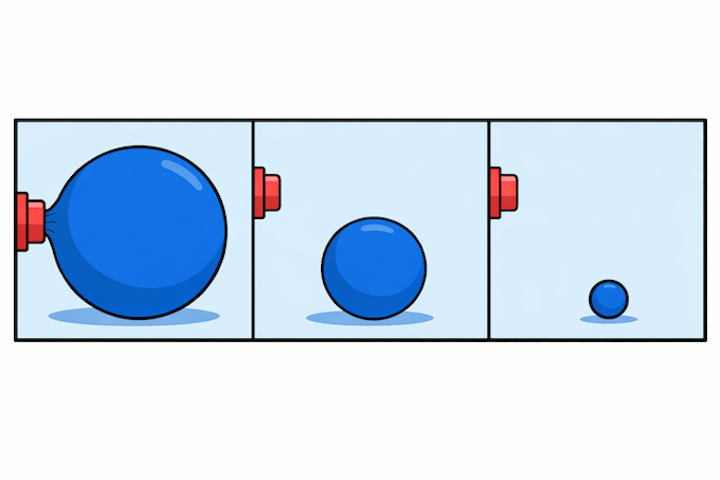
If you look at the illustration above, the first panel represents the earliest stage of grief. The ball nearly fills the entire space. It presses constantly against the small red button on the wall—the trigger. In those early days, everything touches it. Every thought. Every memory. Every quiet moment. The grief is so large that it seems impossible not to feel it, every minute of every day.
Over time, though, the ball begins to shrink. The grief doesn’t disappear—it simply becomes smaller within the space of your life. Now there is a little distance between the ball and the trigger. You can move through a day without every moment setting it off. Of course, it still happens. A song, a scent, a photograph, a familiar place. The grief rolls across the space and presses that button again. But the episodes come less often, and they don’t last quite as long.
Eventually, the grief becomes a much smaller sphere. Most days, you hardly notice it sitting quietly in the corner. Life fills the space again—work, laughter, family, ordinary moments. You may even go stretches of time forgetting the button is there at all.
And then, without warning, something bumps the ball just right. It rolls across the room and lands squarely on that tiny red trigger. In an instant, the grief is back—sharp and powerful enough to bring you to your knees. That part never completely goes away.
But here is the important thing: the ball grows smaller because your life grows larger around it. New experiences, new joys, new relationships expand the space. The grief is still part of you, but it no longer occupies everything.
So if you are in that first stage—when the ball fills the entire frame—please know this: it will not always feel this way. The space around it will grow again. Your breathing will steady. Light will return in unexpected places.
And if the button gets pushed again someday—and it will—remember that it isn’t a failure of healing. It’s simply love echoing through time. And love, even when it hurts, is never something we should wish away.